TL;DR: Find logo designers on platforms like Behance, Dribbble, Upwork, Fiverr, Contra, and 99designs. Compare portfolios, process, pricing, and deliverables—not just the lowest quote. Professional logo projects typically cost $500–$2,500+ and take 2–6 weeks, depending on complexity. (Last updated on October, 2, 2026)
Quick Answer: How to Find a Logo Designer in 7 Steps
- Start with the right platform based on your budget and project needs — see where to find logo designers.
- Review portfolios carefully and look for work relevant to your industry or preferred style — view logo portfolio.
- Compare pricing realistically before choosing the cheapest quote — see logo designer pricing.
- Ask about the design process, revisions, and deliverables before hiring — see what to ask a logo designer.
- Check the expected turnaround time and whether the designer can meet your launch deadline — see logo design timeline.
- Choose experience and strategic thinking over visual style alone — see how to evaluate a designer.
- Review real project outcomes and completed work before making a final decision — view logo portfolio.
How to Find and Hire a Logo Designer
Finding the right logo designer is easier when you follow a clear process. Start by defining your needs, then search across relevant platforms, compare portfolios, and evaluate each designer before making a final decision.
1. Define What You Need
Start with a clear idea of your business, logo requirements, budget, and timeline.
- Decide whether you need only a logo or a broader brand identity.
- Note your preferred style, industry, and intended applications.
2. Search in the Right Places
Look for designers through portfolio platforms, freelance marketplaces, independent websites, and design studios.
- Browse platforms such as Behance, Dribbble, Upwork, and Contra.
- Use specific searches like “logo designer for startups” or “minimalist logo designer.”
3. Review Relevant Portfolio Work
Focus on the quality and relevance of a designer's previous work rather than choosing based on style alone.
- Look for projects similar to your industry or requirements.
- Check whether the designer can create distinct concepts across different brands.
4. Compare Process, Pricing, and Deliverables
Understand exactly what is included before comparing quotes.
- Ask about concepts, revisions, turnaround time, and final file formats.
- Compare the overall value and process—not just the lowest price.
5. Contact and Evaluate Your Shortlist
Reach out to a few suitable designers with a clear project brief.
- Share your business, requirements, budget range, and deadline.
- Evaluate communication, questions asked, and understanding of your needs.
6. Choose the Best Fit and Confirm the Scope
Select the designer who offers the strongest combination of relevant experience, process, and communication.
- Confirm deliverables, ownership rights, timeline, and revision terms.
- Review the final scope before starting the project.
Best Places to Find a Logo Designer
Different platforms offer different advantages depending on your budget, timeline, and level of design support needed. This quick comparison helps you narrow down the best places to find a logo designer before exploring each option in detail.
Platform | Best For | Budget | Timeline | Quick Take |
|---|---|---|---|---|
Behance | Portfolio discovery | $$–$$$ | 1–6 weeks | ✓ Strong portfolios · ✕ Manual outreach |
Dribbble | Style-focused search | $$–$$$ | 1–6 weeks | ✓ Visual quality · ✕ Limited vetting |
Upwork | Freelancer hiring | $–$$$ | Days–6 weeks | ✓ Reviews · ✕ Quality varies |
Fiverr | Small budgets | $–$$ | 1–14 days | ✓ Fast · ✕ Can be generic |
99designs | Multiple concepts | $$–$$$ | 1–3 weeks | ✓ More options · ✕ Less direct |
Toptal | Premium talent | $$$$ | 2–8 weeks | ✓ Screened experts · ✕ Expensive |
LinkedIn | Professional search | $$–$$$$ | 1–8 weeks | ✓ Direct outreach · ✕ Manual vetting |
Local directories | Local collaboration | $$–$$$$ | 1–8 weeks | ✓ Nearby designers · ✕ Smaller pool |
Design communities | Niche talent | $$–$$$ | 1–6 weeks | ✓ Specialists · ✕ Less structured |
Design studios | $$$–$$$$$ | 3–12 weeks | ✓ Strategic process · ✕ Higher cost |
Budget key: $ Under $300 · $$ $300–$1,000 · $$$ $1,000–$5,000 · $$$$ $5,000+
Verification Tip
Don't rely on ratings alone. Check relevant portfolio work, reviews, project history, communication quality, and included deliverables before hiring.
Which Option Is Right for Your Budget and Timeline?
Use this quick decision tree to narrow down where to look based on how much you can invest and how quickly you need your logo.
Under $300 → Need a logo quickly? Explore Fiverr or emerging freelance designers. If your timeline is flexible, browse design communities and independent portfolios for promising talent.
$300–$1,500 → Want a more custom process? Look at Upwork, Behance, Dribbble, or independent designers who offer direct collaboration and tailored concepts.
$1,500–$5,000 → Need broader brand support? Consider experienced independent designers or small design studios that can provide a more strategic process.
$5,000+ → Looking for a complete brand identity? An established branding studio or premium design network may be the better fit.
Short timeline? → If you need your logo within two weeks, prioritize designers with confirmed availability before narrowing your options by platform.
Where Should I Look to Find a Logo Designer With Strong Portfolio Examples?
The portfolio should be one of the most important factors in your search. Look for a designer who shows multiple completed logo projects.
Look for variety in industries, styles, typography, and applications. The key is adaptability, not just industry specialization.
Look for work similar to your needs. A minimalist wordmark, corporate identity, or luxury brand each require different strengths.
Check how logos perform across websites, social media, packaging, business cards, signage, and different sizes.
Look beyond the final logo. Case studies reveal the challenge, design thinking, and how the identity was developed and applied.
A case study can tell you more than a single logo image. When available, look for information about the business challenge, design direction, concept development, final identity, and applications. This gives you insight into how the designer thinks, not just what their finished work looks like.
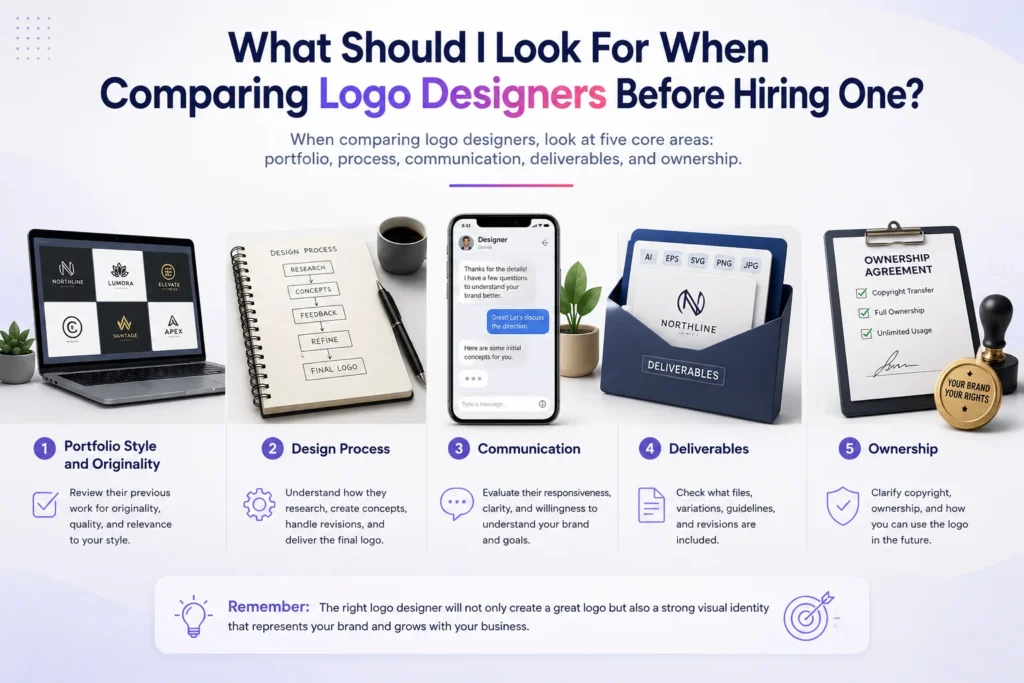
What Should I Look for When Comparing Logo Designers Before Hiring One?
When comparing logo designers, look at five core areas: portfolio, process, communication, deliverables, and ownership.
What About Logo Makers and AI Logo Generators?
Logo makers and AI logo generators can be useful when you need something quickly or want to explore basic visual ideas.
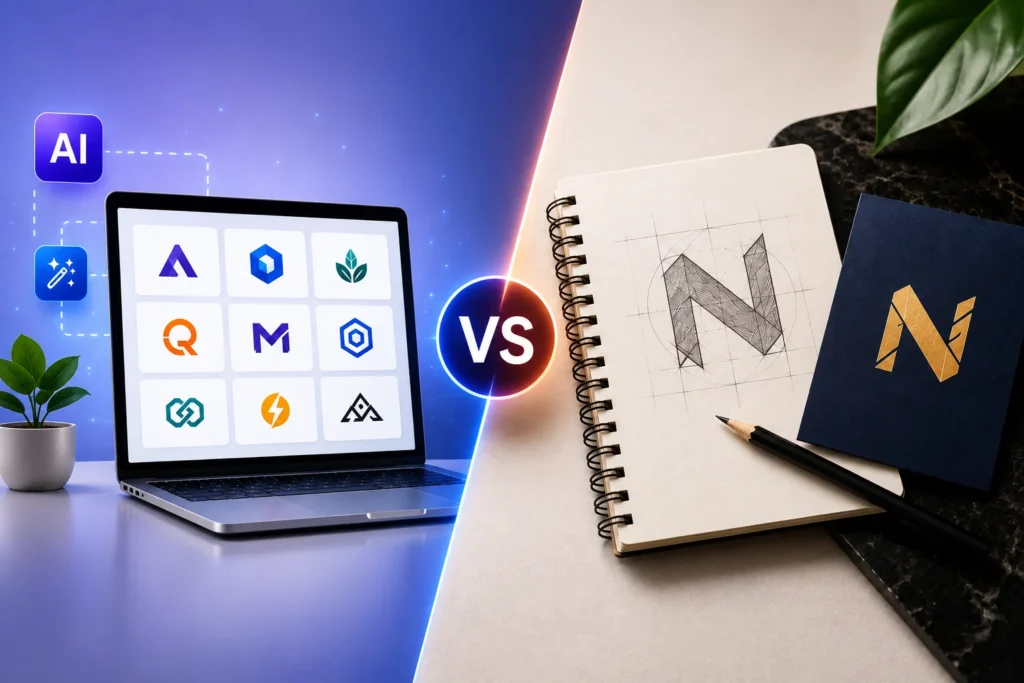
They can be appropriate for:
- Temporary projects
- Early prototypes
- Personal experiments
- Very limited budgets
- Testing different visual directions
However, businesses should consider the limitations before using an automatically generated logo as their long-term identity.
A custom logo designer can make decisions around typography, proportions, symbolism, visual hierarchy, scalability, and brand differentiation that go beyond selecting elements from a predefined system.
If the logo will represent your business for years, a custom-designed identity is generally worth considering.
Red Flags to Watch for When Hiring a Logo Designer
Before choosing a designer, be cautious if you notice:
- Extremely low prices with unrealistic promises
- Little or no relevant portfolio work
- Logos that appear heavily template-based
- No clear revision policy
- Unclear ownership terms
- No explanation of final deliverables
- Only low-resolution files
- No vector artwork
- Very short turnaround promises for complex projects
- Poor communication before the project begins
A professional designer should be able to clearly explain what you are purchasing and what you will receive at the end of the project.
FAQ: Wordmark Logo Examples
You can find logo designers through portfolio platforms, freelance marketplaces, professional networks, referrals, independent websites, and design studios. Choose based on your budget and project needs.
Start by defining your budget, timeline, and project scope. Then shortlist two or three suitable platforms or designers instead of searching everywhere.
Review portfolios for work similar to your preferred style, then compare pricing, process, revisions, and deliverables before contacting designers.
Compare portfolio quality, relevant experience, communication, pricing, turnaround time, revisions, deliverables, and ownership rights—not just visual style.
Behance and Dribbble are useful for portfolio browsing, while independent designer websites and case studies provide deeper insight into completed projects.
Freelance platforms offer flexibility, agencies provide broader support, and referrals add trust. The right option depends on your budget, timeline, and project scope.
Start with Behance, Dribbble, and freelance platforms where you can compare multiple portfolios. Use the platform matrix above to narrow your options.
Search freelance platforms for available designers, ask your network for referrals, or contact designers directly with a clear brief and deadline.
Look for responsive communication, thoughtful questions about your business, a clear process, realistic timelines, and well-defined revision expectations.
Avoid searching every platform. Choose two or three sources based on your budget, then shortlist designers using consistent criteria such as portfolio quality and experience.
Conclusion
Finding the right logo designer starts with knowing your needs. Compare portfolios, design process, communication, pricing, timeline, deliverables, and ownership terms across design platforms, freelancers, and studios.
A strong portfolio matters, but so does the designer's ability to create an original, versatile logo and provide the right files for real-world use. If you need more than a single logo, consider a custom logo system or broader brand identity design to create a consistent visual foundation for your business.